
Trajanje trenutka posljednja je izložba u godišnjem programu Sedimenti vremena – mikrotemporalne ekologije, ciklusa koji je od samog početka tragao za sporijim oblicima pažnje. Lutz Koepnick usporenost razumije kao strategiju suvremenosti, način otvaranja prostora unutar samog ubrzanja, u kojem postaje vidljiva slojevitost sadašnjosti. Vrijeme se u takvoj sadašnjosti istodobno kreće u više smjerova, a usporavanje pogleda omogućuje nam da osjetimo njezine mnogostruke, međusobno razdvojene vremenske tokove (Koepnick 2014, 3, 196). Tijekom godine vrijeme se u Likovnom centru pojavljivalo u sve širim rasponima. Davor Sanvincenti na kraju tog puta okreće pogled prema unutra i prema najmanjem: prema duhu koji vrijeme doživljava i mikroorganizmima koji ga nastavljaju ispisivati u slici. U njegovu izložbenom postavu Koepnickova sadašnjost gotovo poprima tijelo. Trenutak dodira, trajanje zvučnog drona, geološko vrijeme fosila i mikroskopski ritam kvasca susreću se u istoj prostoriji. Ciklus koji je započeo pitanjem kako se vrijeme taloži u krajoliku završava dvjema riječima ispisanima olovkom na bijelom polaroidu: Vrijeme smo.
Naslov izložbe spaja dva pojma koja su u filozofiji vremena dugo stajala u opreci. Za Henrija Bergsona vrijeme je trajanje, durée, neprekinuti tok u kojem se stanja svijesti prelijevaju jedno u drugo bez oštrih granica, dok je trenutak tek presjek koji intelekt naknadno urezuje u tu neprekinutost (Bergson 1889). Gaston Roupnel preokreće takvu predodžbu. Za njega je stvaran samo trenutak, dok se trajanje sastoji od niza trenutaka koji se sami po sebi međusobno ne dodiruju (Roupnel 1927). Gaston Bachelard preuzima Roupnelovu misao u Intuiciji trenutka, razvijajući iz nje tihu, ali postojanu polemiku s Bergsonom (Bachelard 1932). Ipak, ostaje jedno pitanje; ako je trenutak jedina stvarnost, zašto vrijeme doživljavamo kao nešto što traje? Bachelard odgovara pojmom ritma. Trenuci koji se vraćaju i međusobno odjekuju stvaraju dojam neprekinutosti. Trajanje je, prema tome, svojevrsna harmonija trenutaka, nešto što se gradi, uvježbava i održava (Bachelard 1932; 1936). U tom se odjeku otvara prostor Sanvincentijeve izložbe, koja prati kako se trenutak počinje ponavljati, odzvanjati i taložiti sve dok ne poprimi oblik trajanja.
Taj se proces najizravnije očituje u radu Undertow Monochord. U središtu prostora, na metalnom stalku, vodoravno je postavljeno stablo naranče. Korijenje mu je očišćeno, krošnja ogoljena, a između njih napeta je žica koja vibracije prenosi preko drvenog mosta, pretvarajući stablo u glazbeni instrument. Kada ga posjetitelj pokrene, iz unutrašnjosti drva izranja dubok, ambijentalni zvučni dron, u kojem se iz daljine naziru ljudski glasovi. Uz muški glas čuje se i glas francuske vokalistice Isabelle Duthoit, čiji se rad često opisuje kao potraga za jezikom prije jezika, za glasom na samom izvoru govora. Zvuči kao da dopire iz same materije stabla, s praga na kojem ljudsko i neljudsko još nisu razdvojeni.
Monokord je još od antike instrument za ugađanje, pa se i ovaj rad može razumjeti kao čin usklađivanja (attunement), u kojem se dodir, drvo i glas postupno dovode u međusobni odnos. Kathleen Stewart ugađanje opisuje kao osjetilnu usklađenost s atmosferama i materijama koja prethodi razumijevanju (Stewart 2011), dok Pauline Oliveros slušanje razvija kao praksu otvorene pažnje prema svim zvukovima koji ispunjavaju prostor (Oliveros 2005, 25–27). Oliveros pritom poseže za Jungovim konceptom četiriju načina spoznaje, mišljenja, osjećanja, osjeta i intuicije, kroz koje razrađuje praksu dubinskog slušanja (Oliveros 2005, 30–31). Slušanje i individuacija tako se susreću već u radu. Dodir traje tek trenutak. Zvuk koji iz njega nastaje ostaje u prostoru i postupno se gasi. Trenutak se pred nama doslovno pretvara u trajanje.
Od Pitagore nadalje monokord služi kao instrument za istraživanje odnosa broja i zvuka. U djelu Utriusque Cosmi Roberta Fludda božanska se žica proteže od zemlje do neba, usklađujući elemente i nebeske sfere u jedinstvenu harmoniju (Fludd 1617). Sanvincenti tu kozmičku žicu polaže vodoravno, između korijena i krošnje stabla. Riječ undertow označava podvodnu struju koja ispod površine valova povlači prema otvorenom moru. Takav je i zvuk ovog rada, on odvlači slušatelja ispod površine pojavnog, prema unutarnjoj gustoći materije.
Položaj stabla nosi i drugo značenje. Polažući ga vodoravno, Sanvincenti ukida hijerarhiju koju podrazumijeva uspravnost: onu između gornjeg i donjeg, svjetla i tame, svjesnog i nesvjesnog. Krajeve stabla povezuje s animom i animusom, Jungovim pojmom sjedinjenja suprotnih načela (syzygy) (Jung 1951, §§ 20–42). Korijen i krošnja postaju dvije strane iste psihe, tama zemlje i svjetlost zraka, koje se u procesu individuacije trebaju dovesti u odnos. Položeni u istoj ravnini, ostaju u napetoj ravnoteži u kojoj nijedno načelo ne prevladava. Bolivijska sociologinja Silvia Rivera Cusicanqui za takav odnos koristi aimarski pojam ch’ixi. Njime označava sivu boju sastavljenu od sitnih crnih i bijelih točaka koje se nikada potpuno ne stapaju, suživot suprotnosti koje zadržavaju vlastitu narav (Rivera Cusicanqui 2010, 69–70). U toj boji aimarska misao prepoznaje nešto što istodobno jest i nije: sivo koje je bijelo, ali nije bijelo, koje je istodobno bijelo i crno. Rivera Cusicanqui takav odnos naziva logikom uključenog trećeg (Rivera Cusicanqui 2010, 69). Tako i korijen i krošnja Sanvincentijeva stabla postoje jedno uz drugo, u dodiru koji ne zahtijeva njihovo stapanje.
Ako stablo trenutak pretvara u zvuk, polaroid ga pretvara u površinu. U umjetničkoj praksi Sanvincentija polaroid već dugo nosi napetost između brzine medija i sporosti pogleda. U radu Distentio animi pet bijelih polaroida poredano je na zidu. Na svima izostaje slika, a vrijeme se očituje u onome što se dogodilo njihovim površinama. Na prvom koji stoji izdvojeno na početku niza su olovkom ispisane riječi sumus tempus (vrijeme smo). Rečenica zauzima mjesto slike i imenuje onoga tko gleda, uvodeći ga u niz koji slijedi.
Drugi je polaroid nožem razrezan po sredini. Umjetnik ga naziva probušenim vremenom, trenutkom u kojem se otvorila pukotina. Na trećem se jedva nazire maglica, trag kemijske reakcije koja se razvila bez nastanka slike, neodređeni oblik vremena u kojem prošlost ostaje prisutna dok joj se obrisi postupno rastapaju. Četvrti je polaroid zgužvan neposredno nakon nastanka, a zatim ponovno izravnan, pa su nabori ostali utisnuti u njegovu površinu. Zgužvano vrijeme dovodi prošlo i sadašnje u neposredan dodir.
Peti polaroid također stoji izdvojen i nosi natpis nunc stans (stojeća sadašnjost). Njegova je prostorna odvojenost dio rada. Stojeća sadašnjost nalazi se izvan niza, kao točka u kojoj se slijed rezova, maglice i nabora smiruje, u kojoj vrijeme zastaje. Koepnickova usporenost zadržava kretanje i ne prelazi u mirovanje. Sanvincenti joj pridružuje i samu mogućnost zastoja, pa izložba obuhvaća oba pola: usporeno trajanje i trenutak u kojem vrijeme stoji.
Naslov rada preuzima Augustinov izraz iz jedanaeste knjige Ispovijesti. Pitajući se što je vrijeme, Augustin zaključuje da ga mjerimo u vlastitom duhu, rastegnutom između sjećanja na prošlost, pažnje usmjerene na sadašnjost i očekivanja budućnosti (Augustin, Ispovijesti XI, 20, 26; XI, 26, 33). Osam stoljeća kasnije japanski zen-učitelj Dōgen odlazi korak dalje. U tekstu Uji, čiji se naslov prevodi kao bivanje-vrijeme, piše da je vrijeme već samo bivanje i da su sva bića vrijeme (Dōgen 2010). Između tih dviju misli, duha koji mjeri vrijeme i bića koje jest vrijeme, smješten je i natpis na prvom polaroidu.
Sanvincenti izložbu promatra kroz prizmu Jungove psihologije, pa se niz radova može čitati kao put individuacije, od svijesti koja tek imenuje vrijeme prema Jastvu koje povezuje prolazno i vječno. Slikovni jezik za taj proces Jung je pronašao u alkemiji. U Psihologiji i alkemiji faze alkemijskog djela tumači kao projekcije psihičke preobrazbe na materiju. Nigredo označava crnjenje i raspadanje, albedo pročišćenje, a rubedo crvenjenje u kojem se suprotnosti sjedinjuju (Jung 1944, §§ 333–334). Ti nazivi opisuju promjene boje tvari tijekom procesa: njezino tamnjenje, pročišćavanje i žarenje. Prema Jungu, alkemičar je u materiji tražio ono što se odvijalo u njemu samome (Jung 1944, §§ 345–346), pa je vrijeme preobrazbe materije istodobno bilo i vrijeme preobrazbe njegove duše.
Sanvincenti tu shemu prenosi na materijale izložbe, od kojih svaki prolazi kroz vlastiti proces i ritam preobrazbe. Rad Ova sjemenka ne zna da će postati stablo čini mala crno pečena terakotna zdjelica, postavljena na zakrivljeni metalni nosač pričvršćen za zid. Na zemlji kojom je ispunjena leži sjemenka, vidljiva, ali još neproklijala. Glina je izvađena iz zemlje, oblikovana rukom i preobražena vatrom, a sada ponovno prima sirovu zemlju. Crnilo posude pripada fazi nigreda, tami u kojoj započinje alkemijsko djelo, kao i svaki rast. Crna površina ovdje postaje prostor mogućeg klijanja. Sjemenka u njoj miruje kao budućnost koja već postoji, kao vrijeme sadržano u mirovanju.
U radu 1.11.25.29.7.8.9.13. alkemijski se slijed odvija na stolu, slijeva nadesno, kroz niz polaroida i materijala raspoređenih između njih. Na prvom polaroidu iz tame izranjaju mali plamen i šibica kojom je zapaljen. Drugi je potpuno crn, a preko njega položen je komad drvenog ugljena, ostatak onoga što je vatra već progutala. Oba pripadaju fazi nigreda, crnjenju tijekom kojeg se stari oblik raspada.
Treći polaroid uvodi albedo. Na njegovoj svijetloj površini pojavljuje se zamućena sjena ljudske figure. Za Junga je susret sa sjenom, s onim dijelom sebe koji svijest radije ne želi vidjeti, prvi korak individuacije (Jung 1951, §§ 13–14). Uz polaroid su položeni školjka i komad vapnenca s fosilom starim približno 120 milijuna godina, tragom mora koje je nekoć prekrivalo ovo tlo. Spoznaja vlastitog bića tako se pojavljuje uz vremensku perspektivu geoloških razdoblja.
Četvrti i peti položaj prekriveni su pepelom, uz koji se nalaze sitni kamenčići. U alkemiji pepeo pripada procesu kalcinacije, izgaranju koje prethodi nastanku nove tvari. Posljednji polaroid pripada fazi rubeda. U njegovim tonovima hrđe i jantara nazire se figura koja ulazi u svjetlost.
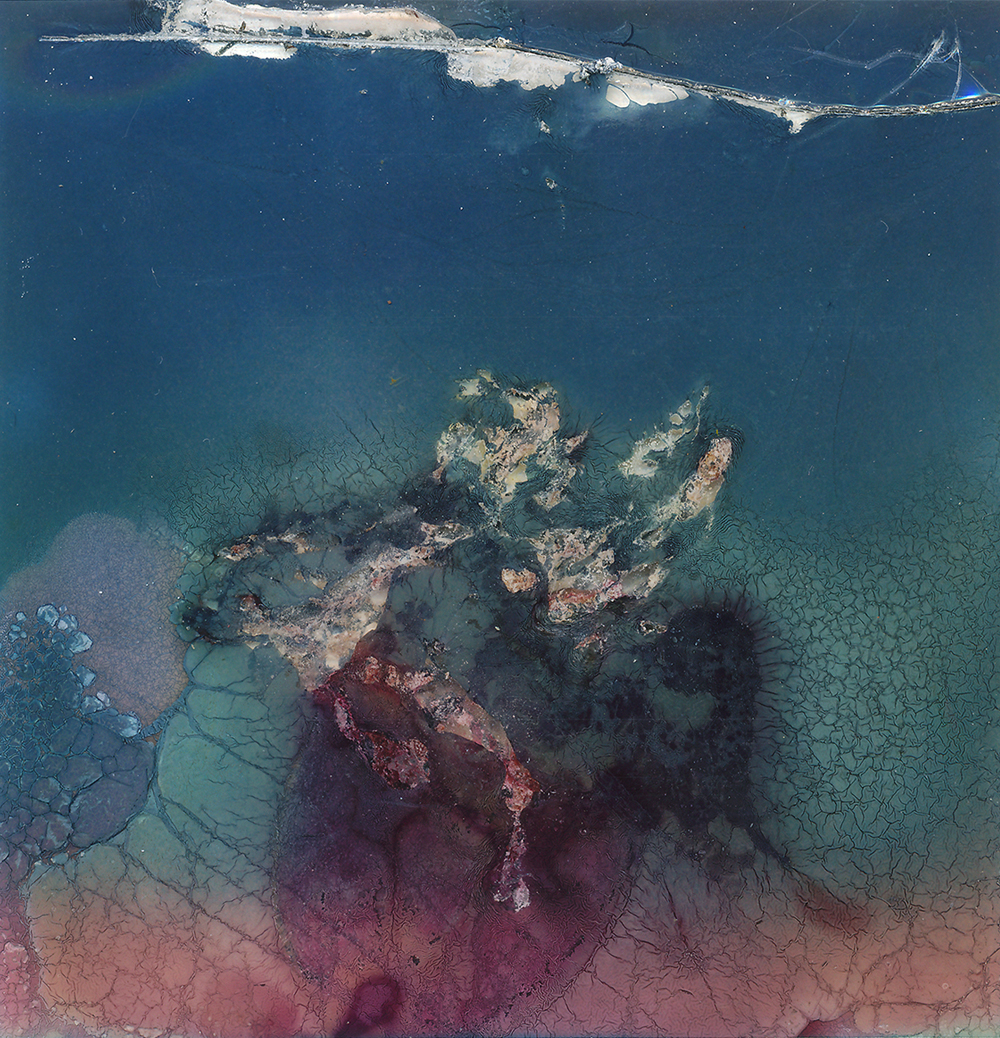
Crvena faza najpotpunije se razvija u dugoj vitrini, u seriji polaroida izrađenih uz pomoć vina. U njihovu su emulziju uneseni živi organizmi, vinski kvasci starih istarskih sorti. Mikroskopski život preuzima kemijsku površinu fotografije, stvarajući na njoj konstelacije oblika i boja koje se mijenjaju sporije nego što ih oko može pratiti. Preobrazba se odvija ispod praga ljudske percepcije. Instantna fotografija, medij stvoren da zaustavi trenutak, ovdje ga ne uspijeva zatvoriti. Slika fermentira, a njezino se trajanje sastoji od bezbrojnih sitnih događaja. Stare istarske sorte u sebi nose talog stoljeća uzgoja, klime i tla, pa svaki polaroid čuva i lokalnu povijest koja se nastavlja ispisivati na površini slike.
Jungovo tumačenje vodi kroz preobrazbu ljudske psihe, dok materijali izložbe istodobno nose vlastita vremenska iskustva koja tu interpretaciju prate i proširuju. Program Sedimenti vremena polazi od ideje osluškivanja vremena koje nadilazi ljudsku mjeru, od trajanja krajolika, mora, svjetlosti i organizama. U Sanvincentijevoj izložbi ta se dva sloja susreću. Preobrazba psihe odvija se usporedno s preobrazbom drva, kamena i kvasca, od kojih svaki u vlastitom ritmu prolazi kroz svoje mijene.
Kvasci u fotografskoj emulziji fermentiraju vlastitim ritmom, a njihovo se vrijeme isprepliće s vremenom pogleda koji ih promatra. Anna Lowenhaupt Tsing takvo ispreplitanje naziva polifonijom: svijetom u kojem ritmovi različitih bića zvuče zajedno, bez zajedničkog, jedinstvenog takta (Tsing 2015, 23–24). Fosil star 120 milijuna godina u sebi čuva vrijeme mora koje je postojalo davno prije pojave bilo kakve psihe, dok sjemenka u crnoj zemlji klija prema vlastitom biljnom vremenu. Robin Wall Kimmerer, botaničarka iz naroda Potawatomi, piše o biljkama kao nositeljicama vlastitih oblika znanja, koji se otkrivaju kroz strpljivo slušanje (Kimmerer 2013, 9–10, 300). U tom svjetlu rečenica „Ova sjemenka ne zna da će postati stablo” dobiva još jedno značenje. Možda sjemenka ipak zna, na način koji nam ostaje nedostupan.
Na zidu je uokviren odlomak koji počinje riječima: „Sve ima svoje doba i svaki posao pod nebom svoje vrijeme.” Riječ je o vremenu koje se sastoji od izmjena, od trenutaka koji se vraćaju u ritmu suprotnosti. Grci su takvo vrijeme nazivali kairos, pravi trenutak, vrijeme koje je za nešto sazrelo, razlikujući ga od kronosa, mjerljivog protoka vremena. Sjemenka u crnoj zemlji živi u kairosu. Ne zna kada će proklijati, ali to je vrijeme već sadržano u njoj, kao što je u stablu naranče sačuvano vrijeme njegova rasta. Između sjemenke i stabla izložba zatvara krug u kojem iz pepela i zemlje ponovno niče život, a linearno vrijeme ustupa mjesto cikličkom. Robin Wall Kimmerer piše da u mnogim autohtonim načinima spoznavanja vrijeme poprima oblik jezera u kojem prošlost, sadašnjost i budućnost postoje istodobno (Kimmerer 2013, 343). Sanvincentijeva izložba nalikuje takvom jezeru. Sjeme, stablo, pepeo i fosil leže jedno uz drugo, a posjetitelj se među njima kreće poput nekoga tko prolazi kroz mirnu vodu vremena.
Literatura
- Augustin, Aurelije. Ispovijesti, XI. knjiga.
- Bachelard, Gaston. 1932. L’Intuition de l’instant. Pariz: Stock.
- Bachelard, Gaston. 1936. La Dialectique de la durée. Pariz: Boivin.
- Bergson, Henri. 1889. Essai sur les données immédiates de la conscience. Pariz: Félix Alcan.
- Dōgen. 2010. „Uji” (1240.). U Treasury of the True Dharma Eye: Zen Master Dōgen’s Shōbō Genzō, ur. Kazuaki Tanahashi. Boston: Shambhala.
- Fludd, Robert. 1617. Utriusque Cosmi Maioris scilicet et Minoris Metaphysica, Physica atque Technica Historia. Sv. 1. Oppenheim: Johann Theodor de Bry.
- Jung, C. G. 1944. Psychologie und Alchemie. Zürich: Rascher. Citirano po paragrafima izdanja Psychology and Alchemy, Collected Works, sv. 12, Princeton: Princeton University Press, 1968.
- Jung, C. G. 1951. Aion: Beiträge zur Symbolik des Selbst. Zürich: Rascher. Citirano po paragrafima izdanja Aion, Collected Works, sv. 9/II, Princeton: Princeton University Press, 1959.
- Kimmerer, Robin Wall. 2013. Braiding Sweetgrass: Indigenous Wisdom, Scientific Knowledge and the Teachings of Plants. Minneapolis: Milkweed Editions.
- Koepnick, Lutz. 2014. On Slowness: Toward an Aesthetic of the Contemporary. New York: Columbia University Press.
- Oliveros, Pauline. 2005. Deep Listening: A Composer’s Sound Practice. New York: iUniverse.
- Rivera Cusicanqui, Silvia. 2010. Ch’ixinakax utxiwa: una reflexión sobre prácticas y discursos descolonizadores. Buenos Aires: Tinta Limón.
- Roupnel, Gaston. 1927. Siloë. Pariz: Stock.
- Stewart, Kathleen. 2011. „Atmospheric Attunements”. Environment and Planning D: Society and Space 29 (3): 445–453.
- Tsing, Anna Lowenhaupt. 2015. The Mushroom at the End of the World: On the Possibility of Life in Capitalist Ruins. Princeton: Princeton University Press.
BIOGRAFIJA UMJETNIKA:
Davor Sanvincenti multimedijski je umjetnik koji se bavi audiovizualnom fenomenologijom i antropologijom vizualne kulture. Studirao je psihologiju na Filozofskom fakultetu u Rijeci i vizualne umjetnosti na Istituto Europeo di Design u Milanu, a magistrirao multimedijsko programiranje i tonsko inženjerstvo na elektroakustičkom centru Agon u Milanu. Radove je predstavio na Device_artu u Montrealu, Biennale des Imaginaires Numériques u Aix-en-Provenceu, Muzičkom biennalu Zagreb te na filmskim festivalima u Rotterdamu, Edinburghu i Ann Arboru. Dobitnik je Nagrade Radoslav Putar (2010.), dviju T-HT nagrada MSU-a (2008., 2017.) i dviju nagrada Oktavijan za eksperimentalni film (2018., 2022.).
The Duration of a Moment is the final exhibition in the annual programme Sediments of Time – Microtemporal Ecologies, a cycle that has sought, from the outset, to explore slower forms of attention. Lutz Koepnick understands slowness as a strategy of contemporaneity, a way of opening up space within acceleration itself, allowing the layered nature of the present to become perceptible. In such a present, time moves in several directions at once, while slowing down the gaze enables us to sense its multiple, disparate temporal flows (Koepnick 2014, 3, 196). Throughout the year, time appeared at the Fine Arts Centre of the City of Zagreb across increasingly expansive scales. At the end of this journey, Davor Sanvincenti turns his gaze inward and towards the smallest: towards the mind that experiences time and the microorganisms that continue to inscribe it into the image. In his exhibition, the present almost takes on a physical form. The instant of touch, the duration of a sound drone, the geological time of a fossil and the microscopic rhythm of yeast meet in the same room. The cycle, which began with the question of how time accumulates in the landscape, concludes with two words written in pencil on a white Polaroid: We are time.
The exhibition title brings together two concepts that have long stood in opposition in the philosophy of time. For Henri Bergson, time is duration, durée: an uninterrupted flow in which states of consciousness merge into one another without sharp boundaries, while the instant is merely a cross-section that the intellect subsequently cuts into this continuity (Bergson 1889). Gaston Roupnel reverses this conception: for him, only the instant is real, while duration consists of a succession of moments that do not touch one another in themselves (Roupnel 1927). In Intuition of the Instant, Gaston Bachelard takes up Roupnel’s thought, developing a sustained polemic with Bergson (Bachelard 1932). Yet one question remains: if the instant is the only reality, why do we experience time as something that endures? Bachelard’s answer lies in the concept of rhythm. Moments that return and resonate with one another create the impression of continuity. Duration is therefore a kind of harmony of moments, something constructed, practised and sustained (Bachelard 1932; 1936). It is within this resonance that Sanvincenti’s exhibition unfolds, tracing how the instant repeats, reverberates and accumulates until it takes on the form of duration.
This process is most directly articulated in the work Undertow Monochord. At the centre of the exhibition space, an orange tree is placed horizontally on a metal stand. Its roots have been cleaned, its crown stripped bare, and a wire stretched between them transmits vibrations through a wooden bridge, transforming the tree into a musical instrument. When activated by a visitor, a deep ambient drone emerges from within the wood, with human voices faintly discernible in the distance. Alongside a male voice, we hear that of the French vocalist Isabelle Duthoit, whose work is often described as a search for language before language, for the voice at the very threshold of speech. It seems to emerge from the matter of the tree itself, from a threshold at which the human and the nonhuman have yet to be separated.
Since antiquity, the monochord has served as an instrument for exploring the relationship between number and sound. In Robert Fludd’s Utriusque Cosmi, the divine string stretches from earth to heaven, connecting the terrestrial and cosmic spheres in a unified harmony (Fludd 1617). Sanvincenti lays this cosmic string horizontally, between the roots and the crown of the tree. The title of the work also points towards a movement beneath the surface: an undertow is a subsurface current that pulls towards the open sea. The sound of the tree acts in a similar way. Rather than remaining at the surface of the sonic event, it draws the listener into a deeper, difficult-to-discern space of matter, voice and vibration.
The monochord can also be understood as an instrument of attunement, through which touch, wood and voice are gradually brought into relation. Kathleen Stewart describes attunement as a sensory alignment with atmospheres and materials that precedes understanding (Stewart 2011), while Pauline Oliveros develops listening as a practice of open attention to all the sounds that fill a space (Oliveros 2005, 25–27). In her approach to Deep Listening, thought, feeling, sensation and intuition come together as four modes of knowing that Oliveros draws from Jung’s conceptual framework (Oliveros 2005, 30–31). Listening thus becomes a form of inner work, a way of establishing a relationship between the conscious and the unconscious. Touch lasts only an instant. The sound that emerges from it remains in the space and gradually fades. Before us, the instant literally becomes duration.
The position of the tree carries another meaning. By laying it horizontally, Sanvincenti alters the customary relationship between roots and crown, earth and air, darkness and light. Within Jung’s symbolic system, this arrangement can be read through the relationship between anima and animus, the feminine and masculine principles that exist in the psyche as opposing yet interconnected forces. Jung describes this pair through the concept of syzygy, pointing to their interdependence within the psychic whole (Jung 1951, §§ 20–42). In the horizontal position of the tree, roots and crown occupy the same plane. Their relationship is no longer defined by vertical hierarchy, but by the tension and balance of two principles that retain their difference. In the process of individuation, such an encounter and the establishment of a relationship between opposing parts of the psyche are essential to the movement towards wholeness.
This reading can be brought into relation with the concept of ch’ixi, developed by Bolivian sociologist Silvia Rivera Cusicanqui. Borrowed from the Aymara language, the term describes a grey surface composed of tiny black and white dots that never fully merge. Rivera Cusicanqui uses it to describe the coexistence of differences that remain alongside one another without losing their distinct nature (Rivera Cusicanqui 2010, 69–70). In this sense, the horizontally positioned tree can be read as an image of a relationship in which opposites meet, interact and remain distinct.
If the tree transforms the instant into sound, the Polaroid transforms it into a surface. In Sanvincenti’s artistic practice, the Polaroid has long carried a tension between the speed of the medium and the slowness of looking. In Distentio animi, five white Polaroids are arranged on the wall. None contains an image; instead, time becomes visible through what has happened to their surfaces. On the first, set apart at the beginning of the sequence, the words sumus tempus (we are time) are written in pencil. The sentence takes the place of the image and names the person looking, drawing them into the sequence that follows.
The second Polaroid has been cut through the middle with a knife. The artist describes it as pierced time, an instant in which a fissure has opened. On the third, a faint haze is barely visible, a trace of a chemical reaction that developed without producing an image, an indeterminate form of time in which the past remains present while its outlines gradually dissolve. The fourth Polaroid was crumpled immediately after it was made and then flattened again, leaving its folds imprinted on the surface. Crumpled time brings the past and the present into direct contact.
The fifth Polaroid is also set apart and bears the inscription nunc stans (the standing present). Its spatial separation is part of the work. The standing present lies outside the sequence, as a point at which the succession of cuts, haze and folds comes to rest, where time stands still. Koepnick’s notion of slowness retains movement and does not become stillness. Sanvincenti adds to it the very possibility of a pause, so that the exhibition encompasses both poles: slowed duration and the instant in which time stands still.
The title of the work draws on a phrase from Augustine’s eleventh book of Confessions. Asking what time is, Augustine concludes that we measure it within our own minds, stretched between memory of the past, attention directed towards the present and expectation of the future (Augustine, Confessions XI, 20, 26; XI, 26, 33). Eight centuries later, the Japanese Zen master Dōgen takes this thought further. In the text Uji, translated as being-time, he writes that time is itself being and that all beings are time (Dōgen 2010). Between the mind that measures time and the being that is time lies the inscription on the first Polaroid.
Sanvincenti approaches the exhibition through the lens of Jungian psychology, allowing the sequence of works to be read as a journey of individuation, from a consciousness that merely names time towards the Self that brings the transient and the eternal into relation. Jung found the visual language for this process in alchemy. In Psychology and Alchemy, he interprets the stages of the alchemical opus as projections of psychic transformation onto matter. Nigredo signifies blackening and dissolution, albedo purification, and rubedo reddening, in which opposites are brought together (Jung 1944, §§ 333–334). These terms describe transformations in the substance itself: its darkening, purification and incandescence. According to Jung, the alchemist sought in matter what was taking place within himself (Jung 1944, §§ 345–346), so that the time of material transformation was simultaneously the time of the transformation of the psyche.
Sanvincenti transfers this scheme to the materials of the exhibition, each of which undergoes its own process and rhythm of transformation. The work This Seed Does Not Know It Will Become a Tree consists of a small, black-fired terracotta bowl mounted on a curved metal support attached to the wall. A seed lies on the soil inside it, visible but not yet germinated. The clay has been extracted from the earth, shaped by hand and transformed by fire; now it receives raw soil once again. The blackness of the vessel evokes the phase of nigredo, the darkness in which the alchemical work begins, as does every process of growth. The black surface becomes a space of potential germination. The seed rests within it as a future that already exists, as time held within stillness.
In the work 1.11.25.29.7.8.9.13., the alchemical sequence unfolds across a table, from left to right, through a series of Polaroids and materials arranged between them. On the first Polaroid, a small flame and the match that lit it emerge from darkness. The second is entirely black, with a piece of charcoal placed across it, the remains of what the fire has already consumed. Both belong to the phase of nigredo, the blackening through which an old form disintegrates.
The third Polaroid introduces albedo. A blurred human figure appears on its pale surface. For Jung, the encounter with the shadow, with the part of oneself that consciousness would rather not see, is the first step towards individuation (Jung 1951, §§ 13–14). Beside the Polaroid lie a shell and a piece of limestone containing a fossil approximately 120 million years old, a trace of the sea that once covered this land. The encounter with one’s own shadow thus takes place alongside the temporal perspective of geological eras, within which human experience occupies only a negligible fraction of a much longer duration.
The fourth and fifth positions are covered with ash, accompanied by small stones. In alchemy, ash belongs to the process of calcination, the burning that precedes the formation of a new substance. The final Polaroid belongs to the phase of rubedo. Within its rust and amber tones, a figure can be discerned entering the light. The red phase is most fully developed in a long display case, in a series of Polaroids made with the help of wine. Living organisms, yeasts from old Istrian grape varieties, have been introduced into their emulsions. Their presence sets changes in motion across the chemical surface of the photograph, producing constellations of forms and colours that change more slowly than the eye can follow. The transformation takes place below the threshold of human perception. Instant photography, a medium created to arrest a moment, fails here to contain it. The image ferments, and its duration consists of countless minute events. Old Istrian grape varieties carry within them the sediment of centuries of cultivation, climate and soil, so that each Polaroid also preserves a local history that continues to inscribe itself on the surface of the image.
Jung’s interpretation follows the transformation of the human psyche, while the materials in the exhibition simultaneously carry their own temporal experiences, accompanying and extending that interpretation. The programme Sediments of Time begins with the idea of listening to forms of time that exceed the human scale: the duration of landscapes, seas, light and organisms. In Sanvincenti’s exhibition, these two layers meet. The transformation of the psyche unfolds alongside the transformation of wood, stone and yeast, each undergoing change according to its own rhythm.
The yeasts in the photographic emulsion ferment according to their own rhythm, and their time becomes intertwined with the time of the gaze observing them. Anna Lowenhaupt Tsing calls this kind of entanglement polyphony: a world in which the rhythms of different beings sound together, without a single, shared beat (Tsing 2015, 23–24). The 120-million-year-old fossil preserves the time of a sea that existed long before the emergence of any psyche, while the seed in the black soil germinates according to its own vegetal time. Robin Wall Kimmerer, a botanist from the Potawatomi Nation, writes of plants as bearers of their own forms of knowledge, revealed through patient listening (Kimmerer 2013, 9–10, 300). In this light, the sentence “This seed does not know it will become a tree” takes on another meaning. Perhaps the seed does know, in a way that remains inaccessible to us.
On the wall hangs a framed passage that begins with the words: “To everything there is a season, and a time to every purpose under the heaven.” It speaks of time as a succession of changes, of moments returning in the rhythm of opposites. The Greeks called such time kairos, the opportune moment, the time when something has ripened, distinguishing it from chronos, the measurable passage of time. The seed in the black soil inhabits its own time of ripening. It does not know when it will germinate, but the possibility of growth is already contained within it, just as the time of its growth is preserved in the orange tree. Between seed and tree, the exhibition establishes a circular relationship in which life emerges again from ash and earth, and linear time gives way to cyclical time. Robin Wall Kimmerer writes that in many Indigenous ways of knowing, time takes the form of a lake in which past, present and future exist simultaneously (Kimmerer 2013, 343). Sanvincenti’s exhibition resembles such a lake. Seed, tree, ash and fossil lie alongside one another, while the visitor moves among them like someone passing through the still waters of time.
References
- Confessions, Book XI.
- Bachelard, Gaston. 1932. L’Intuition de l’instant. Paris: Stock.
- Bachelard, Gaston. 1936. La Dialectique de la durée. Paris: Boivin.
- Bergson, Henri. 1889. Essai sur les données immédiates de la conscience. Paris: Félix Alcan.
- Dōgen. 2010. “Uji” (1240). In Treasury of the True Dharma Eye: Zen Master Dōgen’s Shōbō Genzo, edited by Kazuaki Tanahashi. Boston: Shambhala.
- Fludd, Robert. 1617. Utriusque Cosmi Maioris scilicet et Minoris Metaphysica, Physica atque Technica Historia. Vol. 1. Oppenheim: Johann Theodor de Bry.
- Jung, C. G. 1944. Psychologie und Alchemie. Zürich: Rascher. Cited by paragraph numbers from Psychology and Alchemy, Collected Works, vol. 12, Princeton: Princeton University Press, 1968.
- Jung, C. G. 1951. Aion: Beiträge zur Symbolik des Selbst. Zürich: Rascher. Cited by paragraph numbers from Aion, Collected Works, vol. 9/II, Princeton: Princeton University Press, 1959.
- Kimmerer, Robin Wall. 2013. Braiding Sweetgrass: Indigenous Wisdom, Scientific Knowledge and the Teachings of Plants. Minneapolis: Milkweed Editions.
- Koepnick, Lutz. 2014. On Slowness: Toward an Aesthetic of the Contemporary. New York: Columbia University Press.
- Oliveros, Pauline. 2005. Deep Listening: A Composer’s Sound Practice. New York: iUniverse.
- Rivera Cusicanqui, Silvia. 2010. Ch’ixinakax utxiwa: una reflexión sobre prácticas y discursos descolonizadores. Buenos Aires: Tinta Limón.
- Roupnel, Gaston. 1927. Siloë. Paris: Stock.
- Stewart, Kathleen. 2011. “Atmospheric Attunements.” Environment and Planning D: Society and Space 29 (3): 445–453.
- Tsing, Anna Lowenhaupt. 2015. The Mushroom at the End of the World: On the Possibility of Life in Capitalist Ruins. Princeton: Princeton University Press.