Povezanost svijeta, godine i ljudskog života ima dugu povijest vizualizacije u različitim kulturnim i epistemološkim tradicijama. Dijagram Mundus–Annus–Homo, poznat iz djela De natura rerum Izidora Seviljskog, povezuje svijet, godinu i čovjeka kroz elemente, godišnja doba i tjelesne temperamente. Njegova kružna struktura organizira različite pojave kroz sustav korespondencija u kojem se kozmički poredak, godišnji ciklus i ljudsko tijelo međusobno odražavaju.[1] U mezoameričkim tradicijama vrijeme je dobivalo drukčije vizualne i materijalne oblike. Ritualni ciklus od 260 dana i solarni ciklus od 365 dana odvijali su se paralelno, a njihovo preplitanje povezivalo je kalendarsko vrijeme s ritualnim praksama, sezonskim ciklusima i ljudskim životom. Kalendarski i astronomski sustavi bilježeni su u kodeksima i na kamenim spomenicima, gdje vrijeme postaje čitljivo kroz znakove dana, numeričke sustave i odnose s kretanjem nebeskih tijela.[2] Različite povijesti mjerenja i prikazivanja vremena svjedoče o pokušajima da se ljudsko trajanje smjesti unutar odnosa koji ga prostorno i vremenski nadilaze.
Rad Kronotop (2022–) Neli Ružić ulazi u tu dugu povijest pokušaja da se odnos vremena, čovjeka i kozmosa učini vidljivim. Sunce, Zemlja, godina i materijalna površina papira susreću se u istom procesu, dok brojčana oznaka godine pripada ljudskoj potrebi da vrijeme mjeri, dijeli i imenuje. Godina pritom u sebi već sadrži planetarni odnos. Njezino trajanje proizlazi iz Zemljina obilaska oko Sunca, prevedenog kroz kalendarske sustave u jedinicu kojom organiziramo svakodnevicu, povijest i očekivanja budućnosti.
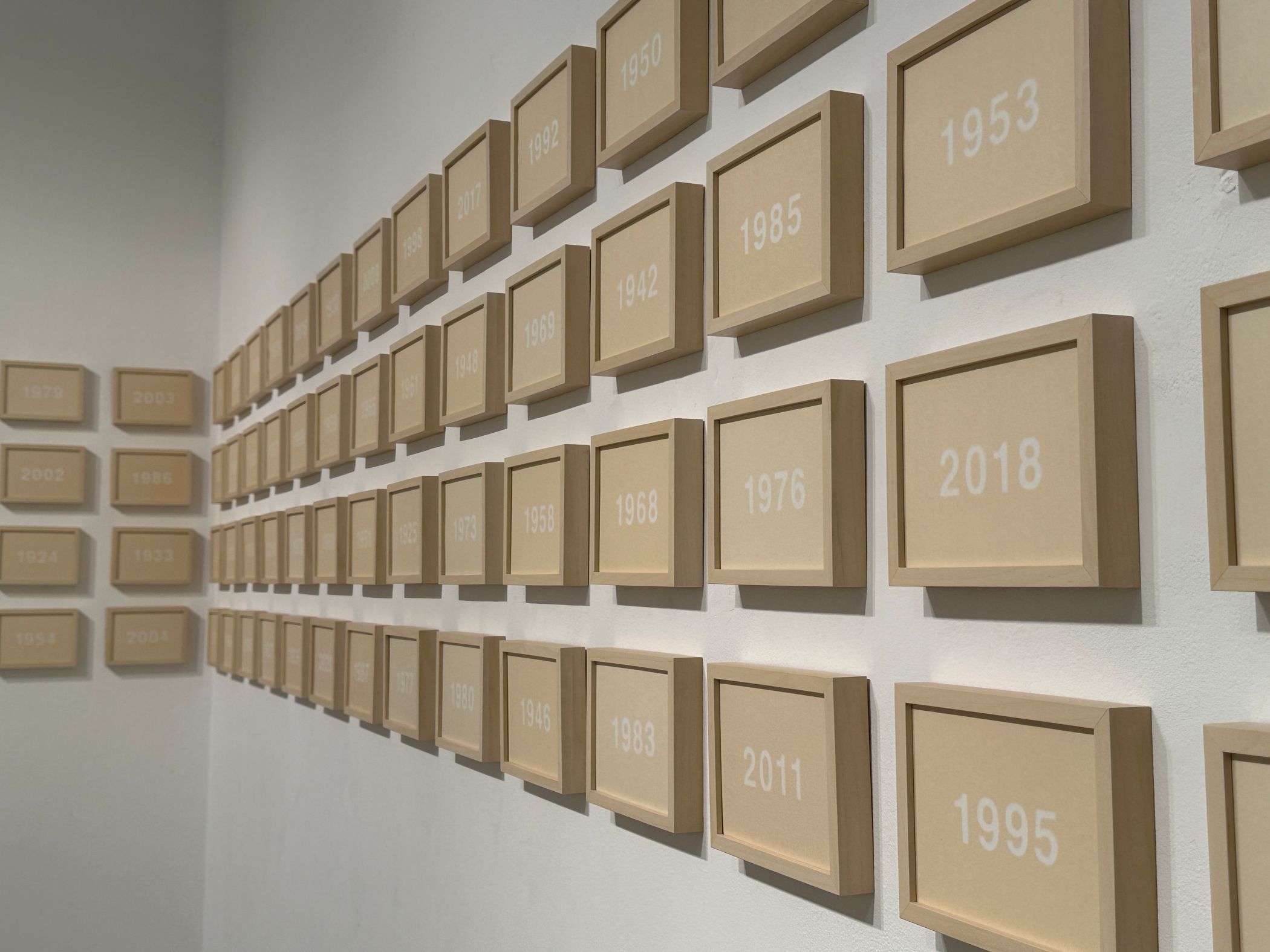
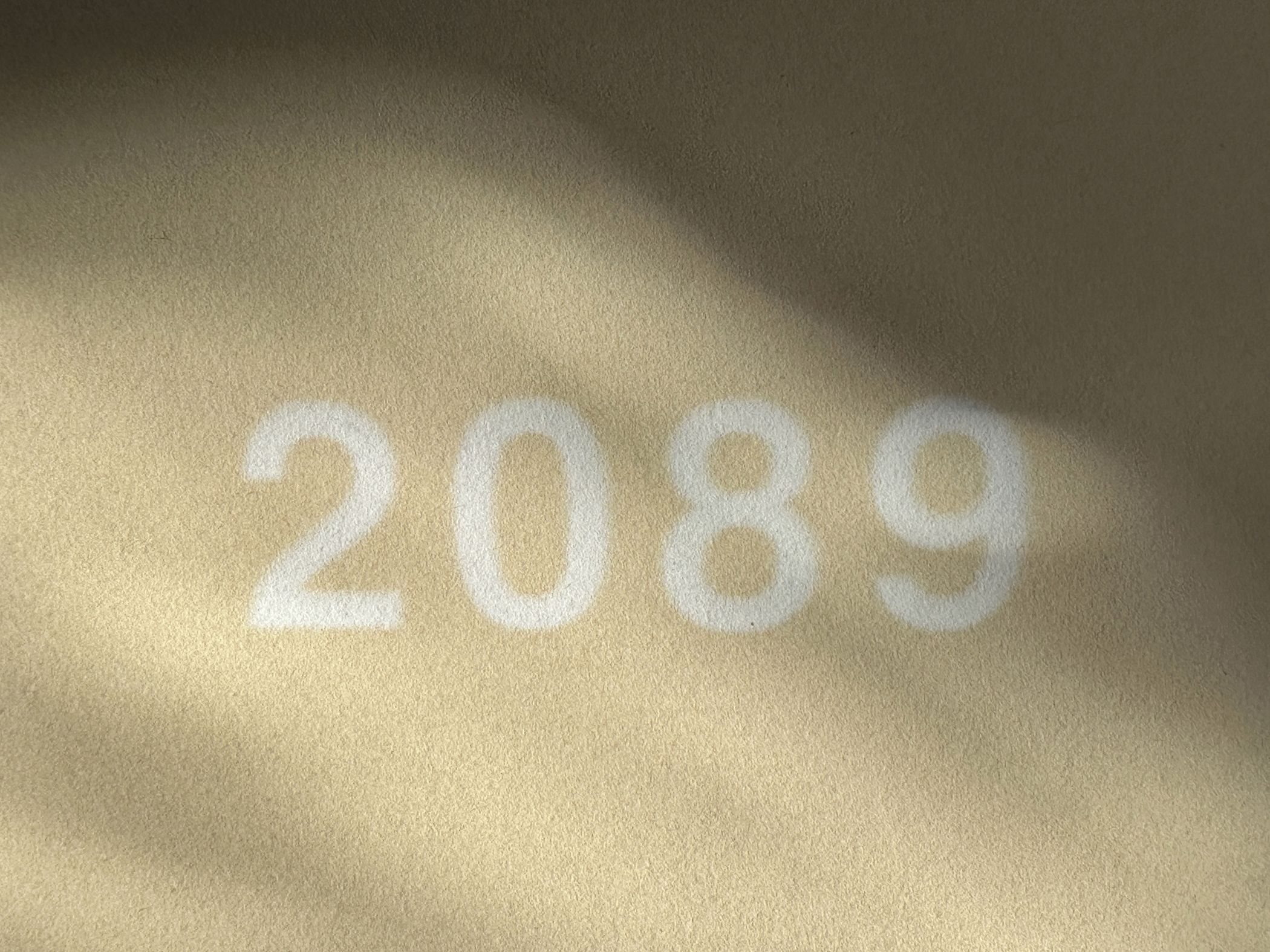
Sunce u Kronotopu ulazi u taj odnos kao aktivna sila. Papiri s otisnutim godinama izlažu se njegovoj svjetlosti tijekom više dana. Pod djelovanjem sunčeve svjetlosti površina papira mijenja boju, dok oznaka godine postupno blijedi. Proces koji proizvodi rad proizlazi iz istog planetarnog odnosa koji određuje trajanje godine. Broj i sunčeva svjetlost pripadaju različitim načinima bilježenja vremena, a na površini papira postaju dijelovi istog materijalnog događaja. Sunce određuje uvjete nastanka rada i ostavlja fizički trag trajanja.
U Likovnom centru Kronotop se razvija u odnosu prema temporalnosti samoga mjesta. Godine od 1927. do 2026. obuhvaćaju povijest kuće Zbirke Kljaković i Likovnog centra, a njihov nekronološki raspored stvara svojevrsno vremensko taloženje unutar izložbenog prostora. Rad uključuje i godine koje se protežu do 2101., uvodeći budućnost u isti prostorni odnos s prošlošću i sadašnjošću. Godine koje tek trebaju doći materijalno su prisutne uz one čiji su tragovi već upisani u povijest kuće.
U tom rasporedu nastaje zanimljiva vremenska asimetrija. Buduće godine već imaju vlastitu materijalnu prošlost, njihove su površine bile izložene Suncu, na njima su se promjene već dogodile i nastavljaju se događati. U tom se procjepu otvara prostor temporalne spekulacije blizak razmišljanju Elizabeth Grosz o budućnosti kao području nastajanja, transformacije i nepredvidivosti. U The Nick of Time Grosz razvija razumijevanje vremena u kojem budućnost posjeduje sposobnost preoblikovanja odnosa prema prošlosti i sadašnjosti, a temporalnu poziciju subjekta smješta između prošlosti i budućnosti bez stabilne sadašnjosti koja bi ih razdvajala.[3]
Materijalna prisutnost budućih godina dodatno remeti ideju urednog linearnog slijeda prošlosti, sadašnjosti i budućnosti. Karen Barad vrijeme promišlja kroz prostorno-vremenske isprepletenosti u kojima se „ovdje“ i „tamo“, „sada“ i „tada“ uzajamno rekonfiguriraju. Temporalnosti se u tom okviru prelamaju jedna kroz drugu, umjesto da se nižu duž jedinstvene i neprekinute vremenske linije.[4] U Kronotopu takva isprepletenost dobiva prostorni oblik. 1927., 2026., 2089. i 2101. mogu se istodobno nalaziti pred nama, materijalno prisutne u istom trenutku, premda svaka zauzima drugu poziciju unutar kalendarske kronologije.
Drugi obrat perspektive pronalazimo kod Kodwoa Eshuna. U eseju Further Considerations on Afrofuturism Eshun započinje spekulativnom scenom afričkih arheologa iz budućnosti koji istražuju ostatke muzeja iz našega vremena. Taj vremenski obrat unutar njegova promišljanja afrofuturizma ima političku dimenziju, povezanu s proizvodnjom povijesnih narativa, kolonijalnim arhivom i mogućnošću konstruiranja drukčijih budućnosti.[5] Za Kronotop je posebno produktivan pomak pozicije promatrača koji takva spekulacija omogućuje. Sadašnjost se može zamisliti kao budući arheološki sloj, a ono što danas nazivamo budućnošću kao vrijeme iz kojeg će se jednom gledati unatrag.
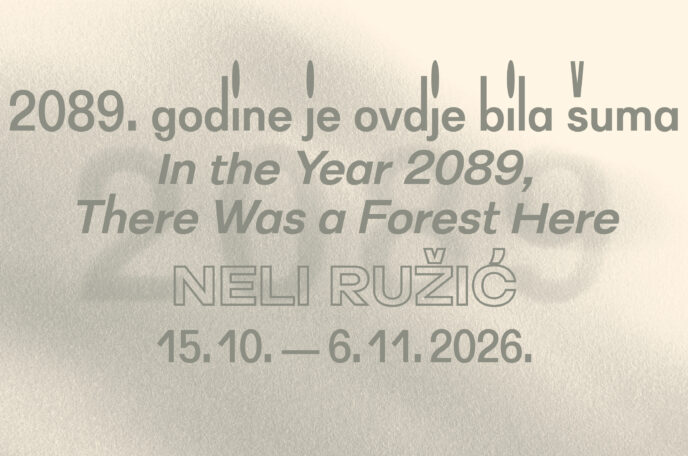
2089. godine je ovdje bila šuma kao da govori iz takve pomaknute vremenske pozicije. Godina 2089. za nas pripada budućnosti, dok je rečenica već smješta u prošlost. „Ovdje“ postaje prostorna koordinata kroz koju se različita vremena presijecaju. Šuma se pojavljuje kao mogući trag ili sjećanje iz vremena čiju sadašnjost još ne poznajemo. Naslov tako uspostavlja svojevrsnu arheologiju unaprijed, u kojoj se današnje mjesto može promatrati kao budući povijesni sloj.
Taj obrat mijenja i status 2026. godine u radu. Ona je za posjetitelja sadašnjost, ali u prostornom rasporedu rada već poprima karakter jednoga od vremenskih slojeva. Godine su oslobođene kronološkog redoslijeda, pa se prošlost, sadašnjost i budućnost pojavljuju u međusobnim odnosima koji se mijenjaju s pozicijom promatrača. Dokumentirana prošlost i spekulativna budućnost zadržavaju svoju vremensku udaljenost, dok ih prostorni raspored čini istodobno dostupnima pogledu.
U tom susretu vremenskih raspona izložba se otvara prema planetarnom. Patricia Reed planetarno razmatra kao trans-skalarnu pojavu koja povezuje različita mjerila, od neposredno materijalnog i lokalnog do atmosferskih, geoloških i infrastrukturnih sustava. Planetarno je sadržano u „svakom zrnu pijeska“ jednako kao u prostranstvu atmosferskih sustava. Različita mjerila postojanja često nadilaze ljudske osjetilne i vremenske registre, pa Reed estetskom iskustvu pripisuje mogućnost njihova posredovanja i razvoja perspektive iz koje sebe možemo ponovno sagledati unutar dinamičnih Zemljinih sustava.[6]
U Kronotopu se prijelaz između mjerila odvija se na maloj površini papira. Takva perspektiva proširuje i značenje mjesta, Reed uz site-specificity razmatra scale-specificity, odnosno potrebu da mjesto promatramo kroz procese koji se odvijaju na različitim mjerilima. Granice lokaliteta postaju propusne kada ih sagledamo iz perspektive atmosferskih i drugih planetarnih procesa. Rokov perivoj u Ružićinu radu tako pripada povijesti kuće i institucije, kao i sezonskim i solarnim ciklusima unutar kojih ta povijest nastaje.
Ružićina 2089. godina pripada proširenoj sadašnjosti. Kalendarski je udaljena više od šest desetljeća, a materijalno je već prisutna pred nama. Papir postoji sada. Sunčeva svjetlost već je djelovala na njegovu površinu. Buduća godina tako stječe trag prije iskustva koje će joj jednoga dana možda pripadati. Uz nju se nalazi 1927., godina čije tragove možemo tražiti u povijesti kuće i grada. Između njih stoji 2026., posebna prije svega zato što je to trenutak iz kojeg je trenutačno promatramo.
Naslov 2089. godine je ovdje bila šuma sada se vraća s drukčijom vremenskom težinom. Njegova šuma pripada spekulativnom prostoru čiji odnos prema našem vremenu ostaje otvoren. Može se pojaviti kao buduće sjećanje, trag promjene mjesta ili slika svijeta promatranog iz vremenske pozicije koju još ne možemo zauzeti. U toj vremenskoj napetosti pojavljuje se mogućnost pogleda koji naslov već zauzima, pogleda iz vremena u kojem se netko prisjeća da je ovdje bila šuma.
— Sabina Oroshi
[1] Dijagram Mundus–Annus–Homo pojavljuje se u ranotiskanoj tradiciji djela De natura rerum Izidora Seviljskog. Drvorez iz izdanja tiskanog 1472. poslije je preuzet kao amblem Warburgova instituta. U njemu su četiri elementa, četiri godišnja doba i četiri temperamenta povezani oko središnjih pojmova svijeta, godine i čovjeka. https://www.sas.ac.uk/sites/default/files/PG-certificate-art-history-and-renaissance-culture-programme-handbook-2025-26.pdf
[2] O mezoameričkim kalendarskim sustavima vidi Anthony F. Aveni, “Mesoamerican Calendars and Archaeoastronomy”. Aveni opisuje 260-dnevni kalendarski ciklus, 365-dnevnu godinu te složenije sustave dugog računanja vremena i njihovu povezanost s astronomskim praksama i kodeksima. 787.–794. str.
[3] Elizabeth Grosz, The Nick of Time: Politics, Evolution, and the Untimely (Durham, NC: Duke University Press, 2004), osobito zaključak “The Future”, str. 244–262.
[4] Karen Barad, “Quantum Entanglements and Hauntological Relations of Inheritance: Dis/continuities, SpaceTime Enfoldings, and Justice-to-Come”, Derrida Today 3, br. 2 (2010), 240–268.
[5] Kodwo Eshun, “Further Considerations on Afrofuturism”, CR: The New Centennial Review 3, br. 2 (2003), 287–302. Eshunov esej otvara scena budućih afričkih arheologa koji iz ostataka muzeja rekonstruiraju kulturnu logiku ranog 21. stoljeća.
[6] Patricia Reed, “Viewing What is Far to See What is Near: On Making Sense of the Planetary”, Stadtkuratorin Hamburg, 2025. Reed posebno razvija pojmove planetarne trans-skalarnosti i scale-specificityja.
BIOGRAFIJA UMJETNICE:
Neli Ružić (Split, 1966.) multimedijska je umjetnica čija praksa istražuje različite temporalnosti, od subjektivne percepcije vremena i sjećanja do povijesnog, biološkog i dubokog geološkog vremena. Radi u medijima instalacije, videa, objekta, intervencija u javnom prostoru te procesualnih, arhivskih i dokumentarnih praksi. U recentnim radovima posebno se bavi svjetlom i sunčevom svjetlošću kao materijalnim i vremenskim fenomenima.
Izlagala je u Hrvatskoj i međunarodno, među ostalim u Taichung Museum of Art na Tajvanu, u okviru BIENALSUR-a u Argentini, Kunsthausu Graz, Ostrale Biennaleu u Dresdenu i Videobrasilu u São Paulu. Dobitnica je Grand Prixa 29. Slavonskog biennala (2024.), nagrade “Jure Kaštelan” za umjetnost (2024.) te Druge nagrade T-HT@msu.hr (2016.). Boravila je na rezidencijalnim programima Headlands Center for the Arts u Kaliforniji i Art Omi u New Yorku. Diplomirala je slikarstvo u Beogradu, a magistrirala na Universidad Autónoma del Estado de Morelos u Meksiku. Redovita je profesorica na Odsjeku za slikarstvo Umjetničke akademije u Splitu.
The relationship between the world, the year, and human life has a long history of visualisation across different cultural and epistemological traditions. The Mundus–Annus–Homo diagram, known from Isidore of Seville’s De natura rerum, connects the world, the year, and the human through elements, seasons, and bodily temperaments. Its circular structure organises different phenomena through a system of correspondences in which cosmic order, the annual cycle, and the human body mirror one another.[1] In Mesoamerican traditions, time took different visual and material forms. The 260-day ritual cycle and the 365-day solar cycle operated in parallel, their interweaving connecting calendrical time with ritual practices, seasonal cycles, and human life. Calendrical and astronomical systems were recorded in codices and on stone monuments, where time becomes legible through day signs, numerical systems, and relationships to the movements of celestial bodies. Different histories of measuring and representing time attest to attempts to situate human duration within relationships that extend beyond it, both spatially and temporally.[2]
Neli Ružić’s Chronotope (2022–) enters this long history of attempts to make the relationship between time, the human, and the cosmos visible. The Sun, the Earth, the year, and the material surface of paper converge in a single process, while the numerical designation of a year reflects the human need to measure, divide, and name time. Yet the year already contains a planetary relationship. Its duration derives from the Earth’s orbit around the Sun, translated through calendrical systems into a unit by which we organise everyday life, history, and expectations of the future.
In Chronotope, the Sun enters this relationship as an active force. Sheets of paper bearing printed years are exposed to sunlight over several days. Under its influence, the surface of the paper changes colour, while the designation of the year gradually fades. The process through which the work takes form thus derives from the same planetary relationship that determines the duration of a year. Numbers and sunlight belong to different ways of recording time, however, on the surface of the paper they become part of the same material event. The Sun determines the conditions of the work’s production and leaves a physical trace of duration.
At the Art Centre, Chronotope develops in relation to the temporality of the site itself. The years from 1927 to 2026 encompass the history of the house of the Kljaković Collection and the Art Centre, while their non-chronological arrangement creates a kind of temporal sedimentation within the exhibition space. The work also includes years extending to 2101, bringing the future into the same spatial relationship with the past and present. Years that have yet to come are materially present alongside those whose traces are already inscribed in the history of the house.
This arrangement produces an intriguing temporal asymmetry. Future years already have a material past of their own: their surfaces have been exposed to the Sun, and changes have already occurred upon them and continue to unfold. Within this gap, a space of temporal speculation opens up, close to Elizabeth Grosz’s understanding of the future as a realm of becoming, transformation, and unpredictability. In The Nick of Time, Grosz develops an understanding of time in which the future has the capacity to reshape relationships to the past and present, positioning the subject temporally between past and future without a stable present separating the two.[3]
The material presence of future years further disrupts the idea of an orderly, linear progression from past to present to future. Karen Barad approaches time through spatiotemporal entanglements in which “here” and “there”, “now” and “then” mutually reconfigure one another. Within this framework, temporalities fold through one another rather than following a single, uninterrupted timeline. In Chronotope, this entanglement takes spatial form. The years 1927, 2026, 2089, and 2101 can all be before us simultaneously, materially present in the same moment, although each occupies a different position within calendrical chronology.[4]
A further shift in perspective can be found in Kodwo Eshun’s writing. In his essay Further Considerations on Afrofuturism, Eshun opens with a speculative scene in which African archaeologists from the future investigate the remains of museums from our own time. Within his thinking on Afrofuturism, this temporal reversal has a political dimension, linked to the production of historical narratives, the colonial archive, and the possibility of constructing different futures. For Chronotope, what is particularly productive is the shift in the observer’s position that such speculation makes possible. The present can be imagined as a future archaeological layer, while what we now call the future becomes a time from which someone will one day look back.[5]
In the Year 2089, There Was a Forest Here seems to speak from just such a displaced temporal position. For us, the year 2089 belongs to the future, while the sentence already places it in the past. “Here” becomes a spatial coordinate through which different times intersect. The forest appears as a possible trace or memory from a time whose present we do not yet know. The title thus establishes a kind of archaeology in advance, in which the site as it exists today can be regarded as a future historical layer.
This reversal also changes the status of the year 2026 within the work. For the visitor, it is the present, yet within the work’s spatial arrangement it already takes on the character of one temporal layer among others. Freed from chronological order, the years allow past, present, and future to enter into relationships that shift with the observer’s position. The documented past and the speculative future retain their temporal distance, while their spatial arrangement makes them simultaneously available to view.
Through this encounter between different temporal spans, the exhibition opens onto the planetary. Patricia Reed considers the planetary as a trans-scalar phenomenon connecting different scales, from the immediately material and local to atmospheric, geological, and infrastructural systems. The planetary is present in “every grain of sand” as much as in the vastness of atmospheric systems. Different scales of existence often exceed human sensory and temporal registers, and Reed attributes to aesthetic experience the capacity to mediate between them and develop perspectives from which we can reconsider ourselves within the Earth’s dynamic systems.[6]
In Chronotope, the passage between scales takes place on the small surface of a sheet of paper. This perspective also expands the meaning of site. Alongside site-specificity, Reed considers scale-specificity, or the need to understand a site through processes unfolding at different scales. The boundaries of a locality become permeable when viewed from the perspective of atmospheric and other planetary processes. In Ružić’s work, Rokov perivoj thus belongs to the history of the house and the institution, as well as to the seasonal and solar cycles within which that history unfolds.
Ružić’s year 2089 belongs to an expanded present. In calendrical terms, it lies more than six decades away, yet materially it is already present before us. The paper exists now. Sunlight has already acted upon its surface. A future year thus acquires a trace before the experience that may one day belong to it. Beside it is 1927, a year whose traces can be sought in the history of the house and the city. Between them stands 2026, distinct above all because it is the moment from which we currently observe it.
The title In the Year 2089, There Was a Forest Here now returns with a different temporal weight. Its forest belongs to a speculative space whose relationship to our own time remains open. It may appear as a future memory, a trace of the transformation of a place, or an image of the world viewed from a temporal position we cannot yet occupy. Within this temporal tension emerges the possibility of the viewpoint the title already assumes: a view from a time in which someone remembers that there was a forest here.
— Sabina Oroshi
[1] The Mundus–Annus–Homo diagram appears in the early printed tradition of Isidore of Seville’s De natura rerum. A woodcut from an edition printed in 1472 was later adopted as the emblem of the Warburg Institute. In it, the four elements, four seasons, and four temperaments are linked around the central concepts of world, year, and human.
[2] On Mesoamerican calendrical systems, see Anthony F. Aveni, “Mesoamerican Calendars and Archaeoastronomy”. Aveni discusses the 260-day calendrical cycle, the 365-day year, more complex long-count systems, and their connections to astronomical practices and codices, pp. 787–794.
[3] Elizabeth Grosz, The Nick of Time: Politics, Evolution, and the Untimely (Durham, NC: Duke University Press, 2004), especially the conclusion, “The Future”, pp. 244–262.
[4] Karen Barad, “Quantum Entanglements and Hauntological Relations of Inheritance: Dis/continuities, SpaceTime Enfoldings, and Justice-to-Come”, Derrida Today 3, no. 2 (2010), 240–268.
[5] Kodwo Eshun, “Further Considerations on Afrofuturism”, CR: The New Centennial Review 3, no. 2 (2003), 287–302. Eshun’s essay opens with a scene of future African archaeologists reconstructing the cultural logic of the early twenty-first century from the remains of museums.
[6] Patricia Reed, “Viewing What is Far to See What is Near: On Making Sense of the Planetary”, Stadtkuratorin Hamburg, 2025. Reed develops the concepts of planetary trans-scalarity and scale-specificity.
ARTIST BIOGRAPHY:
Neli Ružić (Split, 1966) is a multimedia artist whose practice explores different temporalities, ranging from the subjective perception of time and memory to historical, biological, and deep geological time. She works across installation, video, objects, interventions in public space, and process-based, archival, and documentary practices. Her recent work has focused particularly on light and sunlight as material and temporal phenomena.
She has exhibited in Croatia and internationally, including at the Taichung Museum of Art in Taiwan, BIENALSUR in Argentina, Kunsthaus Graz, the Ostrale Biennale in Dresden, and Videobrasil in São Paulo. She received the Grand Prix of the 29th Slavonian Biennale (2024), the Jure Kaštelan Award for Art (2024), and Second Prize at T-HT@msu.hr (2016). She has participated in residency programmes at Headlands Center for the Arts in California and Art Omi in New York. She graduated in painting in Belgrade and received her MA from the Universidad Autónoma del Estado de Morelos in Mexico. She is a full professor in the Painting Department at the Arts Academy in Split.